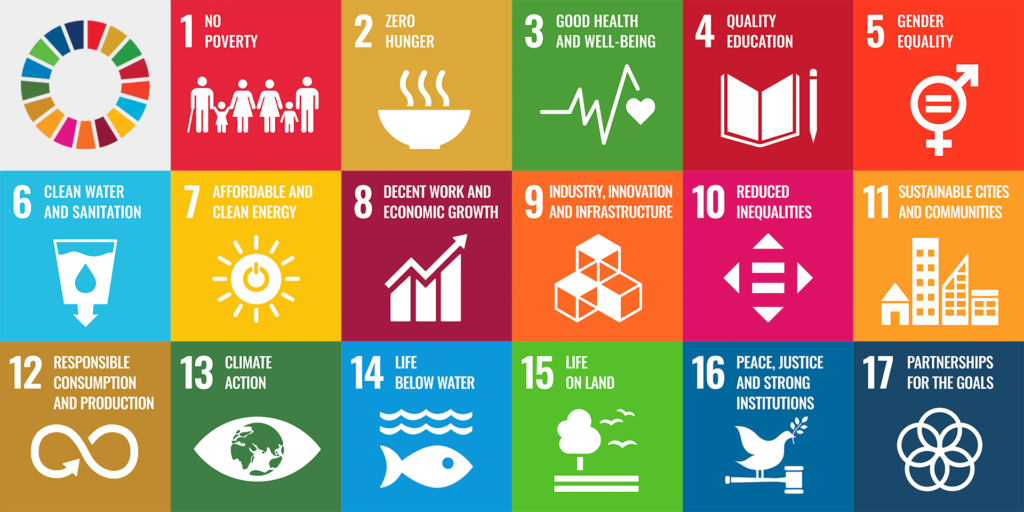
United Nations Sustainable Development Goals

United Nations Sustainable Development Goals

Trinseo is committed to aligning our sustainability efforts with the United Nations Sustainable Development Goals (SDGs), which provide a shared blueprint for peace and prosperity for people and the planet, now and into the future.

When we established our Sustainability Goals, we strategized our product portfolio goal with applications aligning with the SDGs because of the role we play in developing materials that are intrinsic to daily lives.

Our efforts focused on addressing the five SDGs below in accordance with their relevance to our business. As we continue to strive forward with all our goals, we will be expanding our alignment with the SDGs.

SDGs Alignment
The SDG help guide our sustainability journey by providing a roadmap that unifies our efforts with global initiatives.
As part of our decarbonization strategy, Trinseo continues to bring renewable energy sources online across our global facilities. In 2025, our Tessenderlo, Belgium, site activated its newest installation of 664 solar panels, engineered specifically for the site’s uniquely inclined warehouse roof. Other sites with active solar installations include Hamina, Finland, and Terneuzen, the Netherlands. 
 
The new solar installation generates approximately 2.5% of the site’s total annual electricity consumption. Combined with the wind energy integration that Tessenderlo has been running since 2021 through a long-term power purchase agreement—which contributes roughly 25% of annual consumption—the facility now sources approximately 27.5% of its electricity from renewable energy sources. 
 
Building on this momentum, Trinseo has initiated the development of an on-site solar plant at its Rheinmünster, Germany, site. Once operational, this installation is expected to supply approximately 18% of the site’s yearly electricity demand. In parallel, Trinseo expanded its renewable energy portfolio globally by signing its first solar power purchase agreement in Asia for its site in Merak, Indonesia. 
 
These efforts support SDG Target 7.2, which focuses on increasing the share of renewable energy in the global mix, and SDG Target 7.3, which aims to double the rate of improvement in energy efficiency.
Recycling and reuse remain critical to the responsible production and consumption of plastics, and in 2025, we continued expanding our portfolio of recycled content-containing solutions and deepening the partnerships that help contribute to circularity. 
 
Two milestones this year shed particular light on the progress we are making. In early 2025, Trinseo became the first company in Europe to introduce a dissolution recycled polystyrene (rPS) approved for direct food contact applications. Produced at our Schkopau facility in Germany and compliant with EU Regulation 2022/1616, the resins contain 30% recycled content and deliver an approximately 18% lower product carbon footprint versus its virgin equivalent. 
 
Additionally, through our collaborations with Indaver, Trinseo announced that STYRON™ PS, MAGNUM™ ABS and TYRIL™ SAN resins—produced with chemically recycled styrene monomer through depolymerization—are available as dropin solutions, also suitable for food contact applications. 
 
These efforts directly support SDG Target 12.4 and SDG Target 12.5, reinforcing our commitment to reducing waste through recycling and reuse.
At Trinseo, we are raising the bar on our decarbonization commitments and illuminating a clearer path forward on climate action across our Scope 1, 2 and 3 emissions. 
 
In 2025, Trinseo’s Climate Operations and Suppliers (COS) Council completed a comprehensive review of our climate-related Sustainability Goals. The result: three enhanced goals that reflect both our progress to date and our ambition for what comes next. 
 
Our Scope 1 & 2 GHG emissions intensity reduction target has been raised from 35% to 50% by 2035 (with 2017 as the base year), with a new interim milestone of 45% reduction by 2030—giving us a structured, measurable path to track progress along the way. We have also sharpened our electricity goal to focus specifically on renewable sources, targeting 30% of our electricity from renewables by 2030 (with 2017 as the base year). This update reflects the growing availability of renewable energy solutions across our global operations. Having established our Scope 3 baseline and management system in 2024, we are now focused on maintaining an annually updated Scope 3 Inventory and continuously strengthening the methodology behind it, so that our data stays accurate and actionable. 
 
These enhanced goals build directly on the strong foundation our original goals established. Since 2017, Trinseo has reduced total GHG emissions intensity by 41%, and our facilities continue to drive site-level decarbonization projects that move the needle year over year. The COS Council’s revisions raise the bar while staying grounded in what the data shows is achievable and what the moment demands. 
 
These efforts support SDG Target 13.2, which strives to integrate climate change measures into national policies, strategies and planning.
Trinseo is committed to reducing marine pollution through responsible plastic management and water stewardship across our global operations. As a member of Operation Clean Sweep® (OCS) since 2014, we work to prevent plastic pellet, flake and powder loss. In 2025, our Midland, Michigan, and Louisville, Kentucky, sites became the first U.S. Trinseo facilities to achieve OCS Blue Verification—an independently verified distinction recognizing rigorous resin loss prevention. As of April 2025, all of our European manufacturing sites have achieved external OCS Certification and our other facilities continue to be guided by the OCS principles. 
 
Beyond plastic waste prevention, our sites continue to use circular water cooling systems, condensate and collected rainwater to reduce freshwater intake. Since our 2017 baseline, we have achieved a 30% reduction in freshwater intake, surpassing our initial Sustainability Goal of 20% ahead of schedule. Building on that progress, we introduced an enhanced goal that targets long-term resilience: by 2035, Trinseo will implement water stewardship plans at Trinseo is committed to reducing marine pollution through responsible plastic management and water stewardship across our global operations. As a member of Operation Clean Sweep® (OCS) since 2014, we work to prevent plastic pellet, flake and powder loss. In 2025, our Midland, Michigan, and Louisville, Kentucky, sites became the first U.S. Trinseo facilities to achieve OCS Blue Verification—an independently verified distinction recognizing rigorous resin loss prevention. As of April 2025, all of our European manufacturing sites have achieved external OCS Certification and our other facilities continue to be guided by the OCS principles. Beyond plastic waste prevention, our sites continue to use circular water cooling systems, condensate and collected rainwater to reduce freshwater intake. Since our 2017 baseline, we have achieved a 30% reduction in freshwater intake, surpassing water-dependent facilities in Extremely High or High water-stressed areas. This goal is informed by our Water Risk Assessment, which incorporates forward-looking scenario modeling, watershed-level risk indicators and biodiversity proximity analysis to give us a clearer picture of both how we use water today and whether the water we need will be available in the future. 
 
These efforts support SDG Target 14.1, which aims to prevent and reduce marine pollution of all kinds.
Trinseo continues to engage in strategic partnerships and industry collaborations to drive progress in sustainability across the value chain. In 2025, we collaborated with Lapo Srl, a global leader in eyewear lens manufacturing, to jointly develop demonstration lenses made with Trinseo’s ALTUGLAS™ R-LIFE™ recycled polymethyl methacrylate (PMMA) resin containing a minimum of 86% recycled content and achieving a 27%* reduction in product carbon footprint compared to virgin PMMA. 
 
We also worked with Signify to convert end-of-life lighting components back into high-quality materials for new lighting products through polycarbonate (PC) dissolution. This initiated a close, handson collaboration, with both companies contributing their expertise, resulting in new lampshades contain 75% recycled PC (ISO 14021). 
 
Beyond industry initiatives, our facilities remain actively involved in their local communities, participating in volunteer efforts and sustainability programs. 
 
Through these collaborations, we are supporting SDG Target 17.17, which promotes effective public-private and civil society partnerships.  
 
*Trinseo’s internal calculations adhere to the Product Carbon Footprint standard ISO 14067:2018 
UN Sustainable Development Goals in grid with icons

SHINING THROUGH UNCERTAINTY

Trinseo's Fiscal Year 2025 Sustainability Report

SHINING THROUGH UNCERTAINTY

Trinseo's Fiscal Year 2025 Core Impact Report (English)

SHINING THROUGH UNCERTAINTY

Trinseo's Fiscal Year 2025 Core Impact Report (Chinese)

Ready for a sustainable partnership?

From design to manufacturing, we’ll work hand in hand with you to deliver customized sustainable solutions unique to the needs of your company and customers.

Contact Us
0