This article was originally published in the January 2026 issue of the Renewable Carbon Plastics magazine.
Europe has just taken a major step towards vehicle circularity. EU legislators reached a provisional agreement on a regulation that will replace existing End-of-life Vehicle (ELV) Directive and hard-wire circularity into vehicle design and end-of-life management, including measures to boost plastic recovery and recycled content. The deal still awaits formal approval, but the direction is clear. The automotive ecosystem must convert a greater portion of each vehicle into feedstock for the next one while ensuring reliability, scalability, and the quality required by OEMs.
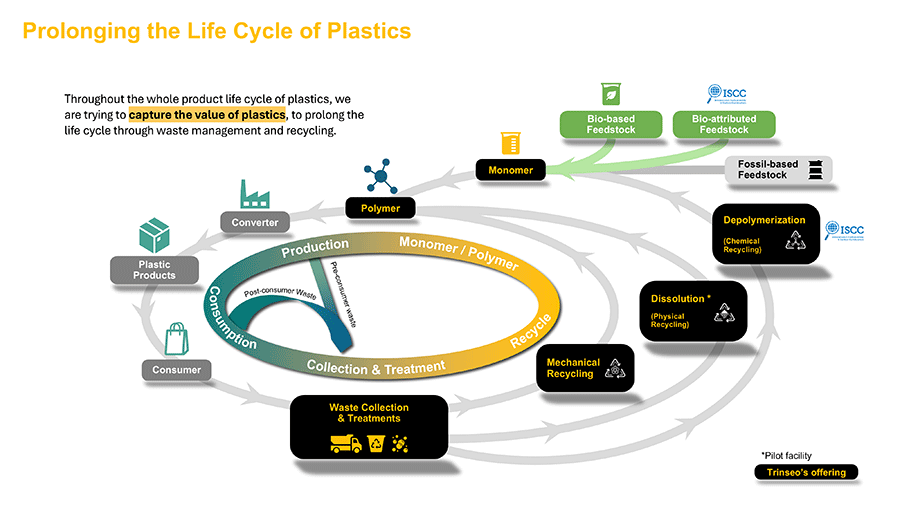
Figure 1: Schematic overview of the plastics life cycle illustrating how value is retained through collection, treatment and multiple recycling pathways. Mechanical recycling, dissolution recycling and depolymerization (chemical) recycling are complementary technologies that enable plastics to re-enter the value chain at polymer or monomer level, alongside fossil-based, bio-based and bio-attributed feedstocks. Trinseo’s dissolution recycling is a physical recycling route capable of upgrading complex, highly formulated plastics and extending material lifetimes.
Automotive parts made from polymers such as PC, ABS and PMMA are used in both interior and exterior applications, including aesthetic and lighting components. These parts are often coated, painted, and are adhered to and with other materials such as different plastics, metals, pigments, fillers, and legacy additives. Traditional mechanical recycling routes excel where streams are simple, single-material comprising; however they struggle when multiphase engineering plastics must be separated from coatings, additives, or other materials that contribute to their functionality. If the goal is to recover the value, the automotive industry needs a way to recycle defined polymer families at high purity.
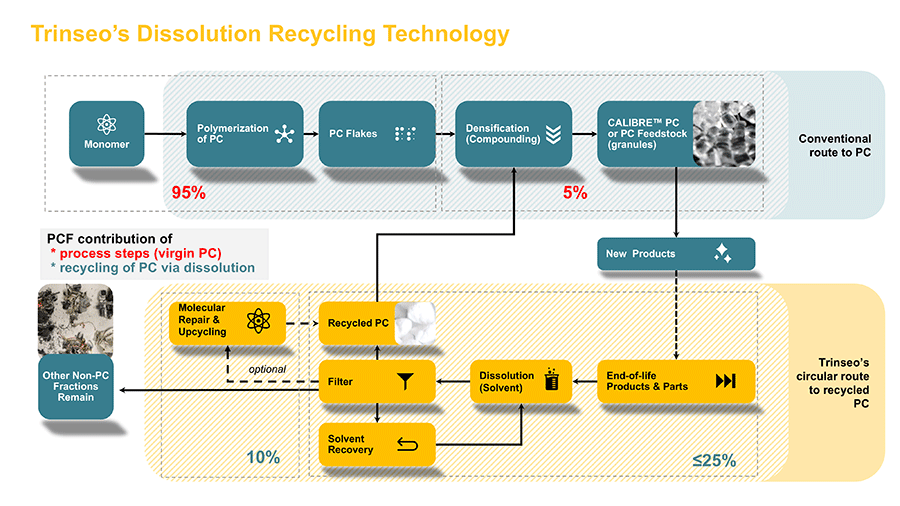
Figure 2: Process schematic comparing the conventional fossil-based route to polycarbonate with Trinseo’s circular dissolution-based recycling route. Highlighted here is the contribution of individual process steps to the polymer carbon footprint (PCF), showing how end-of-life PC products are selectively dissolved, purified and optionally upgraded through molecular repair before re-entering compounding and product manufacturing. High solvent recovery and polymer retention enable a substantial reduction in PCF compared with virgin PC production.
Trinseo’s approach is to treat complex ELV parts as modules, like chemical mixtures on a macro scale. In selective dissolution recycling technologies, a solvent system is chosen that dissolves the target polymer while other non-target materials remain undissolved. From there, a sequence of unit operations are used to purify and obtain high-quality recyclates fit for use in high end automotive applications. It is the versatility and technological advancement of the developed process that allows us to recycle complex ELV streams and thereby fuels our broader strategy to provide recycled content containing products to automotive applications while complying with ELV regulations.
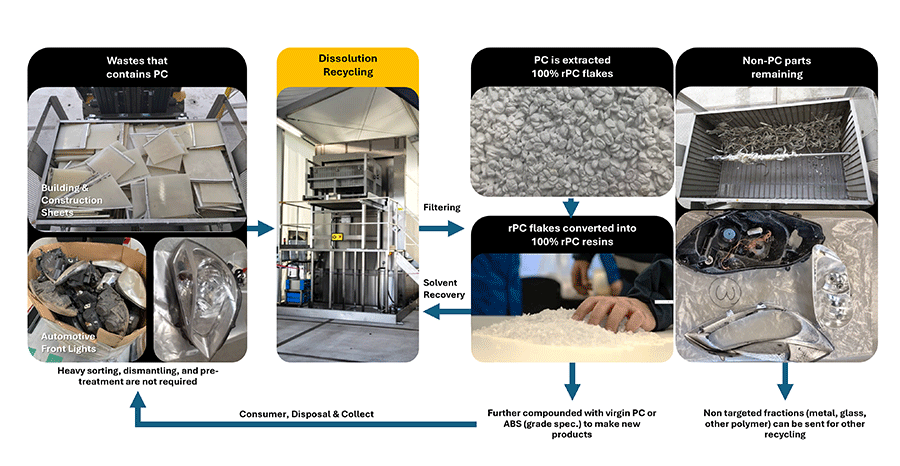
Figure 3: Trinseo’s dissolution-based recycling process for polycarbonate-containing waste streams, including building and construction sheets and automotive lighting parts. Polycarbonate is selectively dissolved and recovered as high-purity rPC flakes and resins, while non-PC components remain undissolved and are separated for appropriate downstream recycling. The recovered rPC can be directly reused or compounded with virgin PC or ABS to produce new products, without the need for intensive pre-sorting or dismantling.
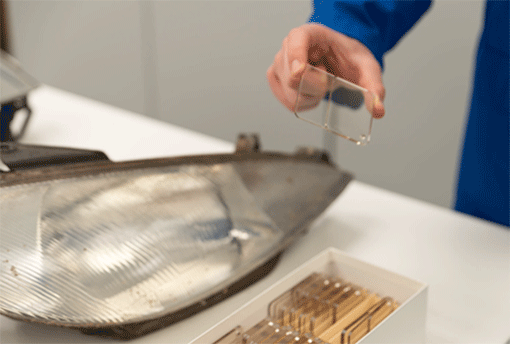
Figure 4: Recovered polycarbonate from end-of-life automotive headlamp components following dissolution recycling, shown as transparent test plaques and molded samples. The material demonstrates high optical clarity and purity, enabling reuse in demanding aesthetic applications.
Dissolution recycling complements mechanical recycling where multiphase or highly formulated engineering plastics are involved, or where purity is critical for re-entry into demanding applications. Choosing the right recycling technology for the right waste type is central to establishing circularity at the best economic and ecological footprint possible.
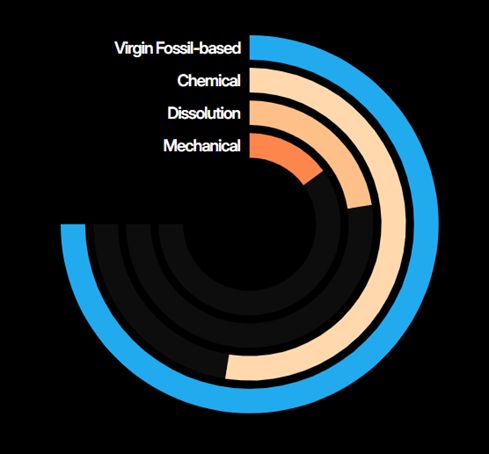
Dissolution combines high quality with significant reduction in PCF while keeping polymers in the value chain
Figure 5: Relative comparison of polymer carbon footprint (PCF) for virgin fossil-based production, chemical recycling, dissolution recycling and mechanical recycling. Dissolution recycling combines high material quality with a substantial reduction in PCF, while keeping polymers within the value chain for high-performance applications.
The new EU regulation promotes circularity throughout the vehicle life cycle, emphasizing design for reuse and recycling, higher-quality and higher yield material recovery, and credible pathways to incorporate recycled content in new vehicles. Trinseo already offers a wide variety of recycled content containing (ex. mechanically recycled) and bio- attributed materials. With the addition of dissolution recycling Trinseo now offers an even more versatile palette of technologies that allow for keeping ELV materials in the value chain and thereby supports product circularity.
Trinseo’s proprietary dissolution recycling technologies raise the bar even further by enabling molecular repair and upgrading possibilities. This may include repairing broken chains, replacing old and deteriorated components, or adding properties that were not there in the material’s previous life.
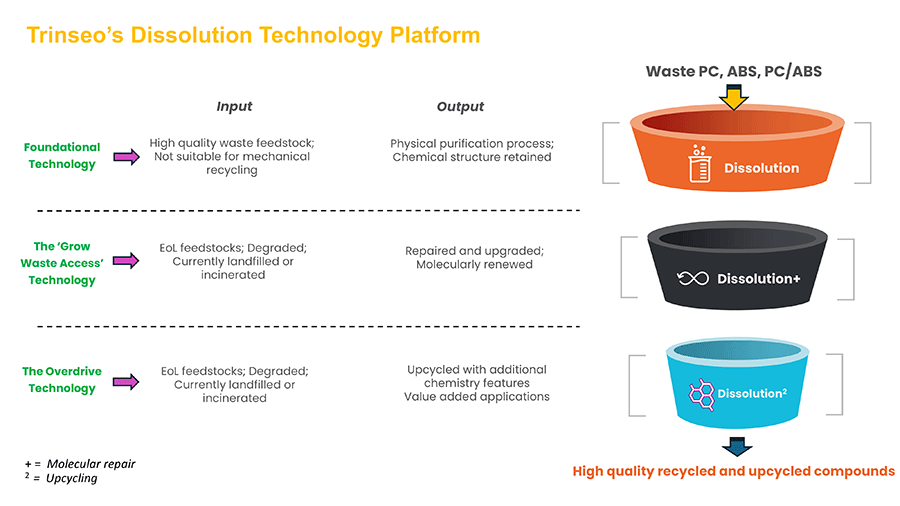
Figure 6: Overview of Trinseo’s dissolution-based recycling technology platform applied to waste PC, ABS and PC/ABS streams. The foundational dissolution process enables physical purification while retaining chemical structure, whereas advanced variants incorporate molecular repair and upcycling to renew degraded polymers or introduce additional functionality, expanding feedstock flexibility and value creation.
Two questions always come up: environmental footprint and scale. Dissolution recycling operates at moderate temperatures with high solvent recovery, and is developed from our multi decade polymer process heritage and know how in solvent based polymer production processes. Our dissolution technology is further advantaged by the ability to produce high-quality recyclates that could replace virgin engineering resins in applications where mechanical recycling is insufficient or has content limitations. The net impact depends on intelligent plant design, energy mix, and allocation rules, but decoupling these polymers from fossil-based virgin raw materials and keeping them in the value chain as long as possible are key potential circular benefits.
Collaboration across the value chain is as important as technological advancements. New collection and dismantling methods need to be implemented for different ELV parts to keep valuable materials segregated. Trinseo’s dissolution recycling, along with mechanical and depolymerization recycling technologies, will purify and recycle engineering thermoplastics and reuse them in compounds with properties tuned specifically for new parts. OEMs are encouraged to become our development partners and validate materials containing recyclates.
Trinseo operates dedicated pilot plants for dissolution-based recycling of polycarbonate (PC) and ABS at its Terneuzen site in the Netherlands, where complex ELV plastics have already been processed at meaningful scale. These pilot facilities have enabled the production of recycled polymers that were subsequently compounded into PC, ABS, and PC/ABS formulations and validated in automotive interior components via injection molding. Parts containing 30 % and 50 % recycled content derived from dissolution recycling have been manufactured and tested, demonstrating performance suitable for demanding interior applications and compliance with the ELV Directive requirements.
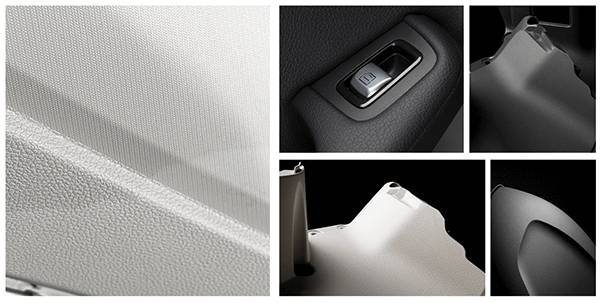
Figure 7: Examples of automotive interior parts produced using PC, ABS and PC/ABS compounds incorporating dissolution-recycled content. The images highlight fine surface textures, consistent grain replication and high aesthetic quality, confirming suitability for visible interior applications.
Building on this validation, Trinseo is now implementing its dissolution technology at commercial scale. the first commercial PC dissolution module is currently being realized in China, with a second module planned in Europe, following the successful start-up of the initial installation. These developments mark the transition of dissolution recycling from pilot-scale proof to an industrially deployable technology for engineering plastics.
The applicability of dissolution recycling beyond automotive is illustrated through the collaboration between Trinseo and Signify, showcased in the accompanying case study. In this project, end-of-life (EoL) streetlight shades collected across the Netherlands were processed at Trinseo’s dissolution facility in Terneuzen to recover high-quality recycled polycarbonate (rPC). The recovered rPC was subsequently used by Signify to 3D-print new pendant lampshades, demonstrating both material circularity and design freedom. The resulting products contain up to 75 % recycled content, are produced on demand to avoid overproduction, and meet the aesthetic and functional requirements of lighting applications. This case study highlights how dissolution recycling enables closed-loop solutions for complex, highly formulated plastics and confirms the technology’s versatility across industries with stringent quality expectations.
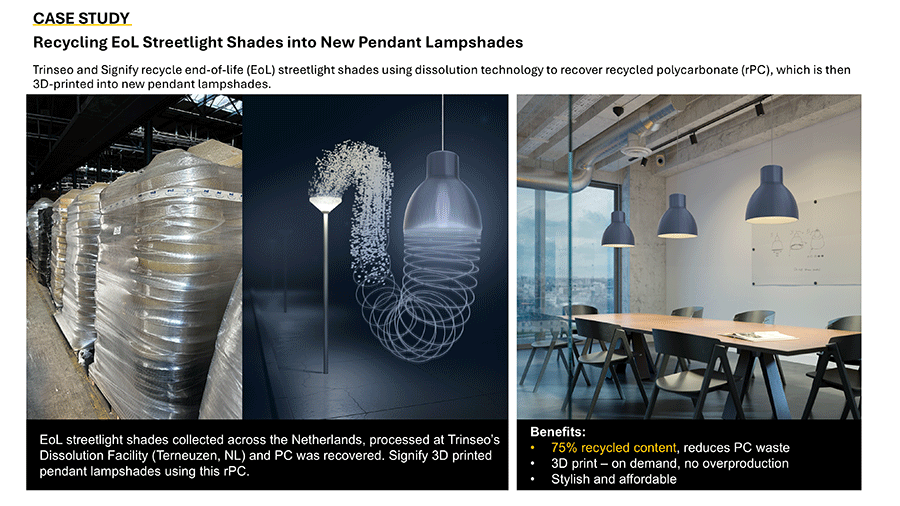
Figure 8: Case study demonstrating the collaboration between Trinseo and Signify, in which end-of-life streetlight shades are collected and processed via dissolution recycling to recover high-quality recycled polycarbonate. The recovered material is subsequently used to 3D-print new pendant lampshades, enabling high recycled content, on-demand production and circular use of engineering plastics in lighting applications
Trinseo is a specialty material solutions provider that partners with companies to bring ideas to life in an imaginative, smart and sustainability-focused manner. Combining premier expertise, future-focused innovations and best-in-class materials, Trinseo unlocks value for companies and consumers alike.
From design to manufacturing, Trinseo taps into decades of experience in diverse material solutions to address its customers’ unique challenges across a wide range of industries, including building and construction, consumer goods, medical and mobility.
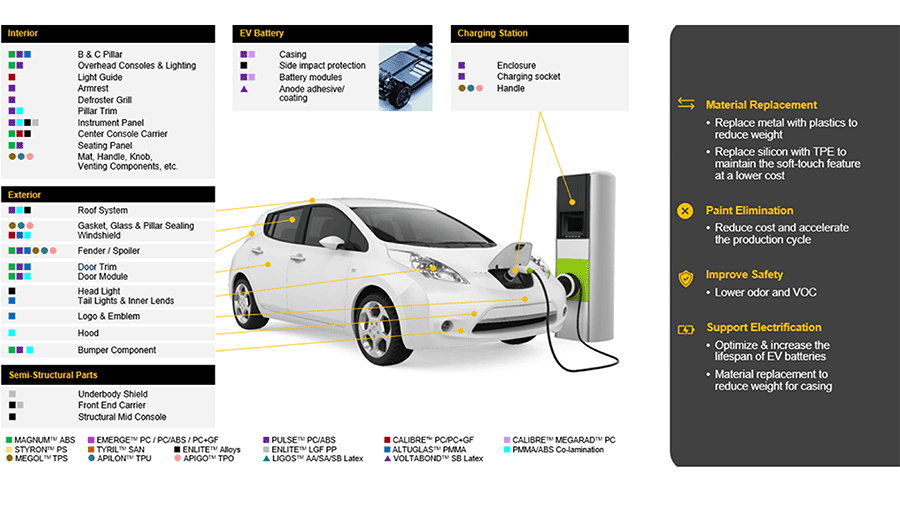
Figure 9: Trinseo's recycled content containing product offerings present opportunities for material substitution, paint elimination, improved safety through reduced VOC emissions, and weight reduction to support vehicle electrification and circular material solutions.
About the Author

Abidin Balan leads dissolution‑based polymer recycling R&D at Trinseo’s Polymer Research Center in the Netherlands, focusing on engineered thermoplastics ABS, PC, SAN, PS, and PMMA. He works with partners across the sustainability ecosystem to turn complex waste streams into application‑ready materials while scaling up technologies from laboratory to commercial production facilities.