To download a PDF of this case study, click here. To learn more about this project, visit us at the 2026 PRSE Show in Amsterdam, May 5 – 6, booth C133.
- The Challenge - A plastic for lamp shades with recycled content coming from a lighting application, demonstrating true closed loop circularity
- The Development - Trinseo’s CALIBRE™ ECO DI, with 75% recycled content based on a lighting waste feedstock
- The Results - Tons of polycarbonate diverted from incineration or landfill, to gain a new life as a luminary, offered with 75% recycled content
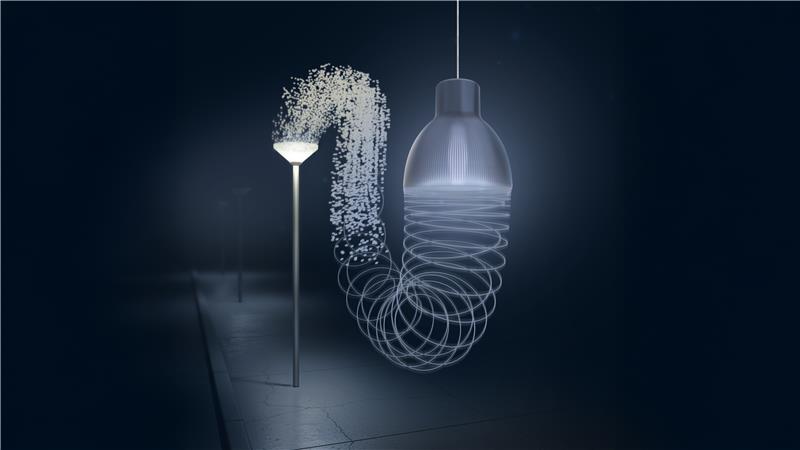
Across Europe, municipalities are rapidly upgrading or retrofitting their streetlighting infrastructure, resulting in thousands of end‑of‑life (EoL) lampshades entering the waste stream every year. Traditionally, these polycarbonate components are destined for incineration or landfilling due to their complex composition and contamination levels, but dissolution-based recycling is one of the key ways to change that. Recognizing both the challenge and the opportunity, Trinseo and Signify jointly embarked on an ambitious project that seeks not just to recycle plastic fractions but to even return them into lighting applications.
The Challenge
To support small‑scale production needs and significantly accelerate response times, Signify has established a dedicated 3D Printing division, Signify myCreation, an innovation hub where new materials and concepts can be introduced to the Signify world with real-life showcases (so-called HERO lighthouse projects).
Building on earlier material innovations, such as the use of polycarbonate recovered from discarded water bottles and polyamide derived from end‑of‑life fishing nets, Signify is now exploring an even more advanced application of circular materials. The opportunity to demonstrate true lighting‑to‑lighting recycling, combined with the potential to achieve a significantly improved recycled content of up to 75%, provided a compelling basis for initiating this joint development project.
For this particular use case, the material must meet very specific optical performance criteria, including achieving a tightly controlled color specification and maintaining a precisely defined light transmission rate. Meeting these parameters is essential to ensure consistent visual quality and lighting performance across applications.
The Development
Trinseo has been advancing its dissolution recycling capabilities at its Terneuzen site for several years, steadily building expertise in this innovative approach to plastic circularity. This long-term commitment culminated in a major milestone in 2025, when the technology was successfully scaled up to a pilot scale facility. The pilot line serves as a crucial steppingstone toward a full-scale plant planned for construction in China, marking Trinseo’s ambition to industrialize dissolution recycling on a global level.
The collaboration between Trinseo and Signify builds on a long and trusted partnership. For decades, the two companies have jointly developed a variety of high-performance virgin plastic solutions, including polycarbonate (PC), PMMA, and ABS, tailored to demanding lighting applications. This long-standing relationship laid a strong foundation for moving into the next frontier.
In 2024, during Trinseo’s PC Dissolution Innovation Day, Signify was introduced to the latest achievements in dissolution technology and its potential for enabling high purity recycled polymers suitable for optical applications. Inspired by this breakthrough, Signify approached Trinseo with a vision to create a circularity project that would convert EoL lighting components back into high-quality materials for new lighting products. This initiated a close, hands-on collaboration, with both companies contributing expertise to make the project a success.
Going from EoL to new luminary, a streetlamp is undergoing the following process:
- Collection - End-of-life streetlight shades are collected across the Netherlands and transported to Heathland Recycling Solutions, Trinseo’s recycling facility in Utrecht. This ensures a clean and traceable waste stream suitable for high-value recycling.
- Recycling - From Utrecht, the materials are sent to Trinseo’s dissolution recycling facility in Terneuzen. Here, the shades undergo recycling through dissolution, which selectively separates, purifies, and recovers recycled polycarbonate (rPC) of exceptionally high quality. The recycled output is then compounded into a defined optical grade CALIBRE™ ECO DI material designed specifically for lighting performance.
- Material Transfer - The resulting rPC granules are delivered to Signify myCreation, Signify’s dedicated 3D-printing and material-innovation hub.
- Manufacturing - At Signify myCreation, the CALIBRE™ ECO DI granules are extruded into filament. This filament serves as feedstock for 3D-printing new pendant lampshades—directly transforming recycled streetlight components into premium lighting products.
The Result
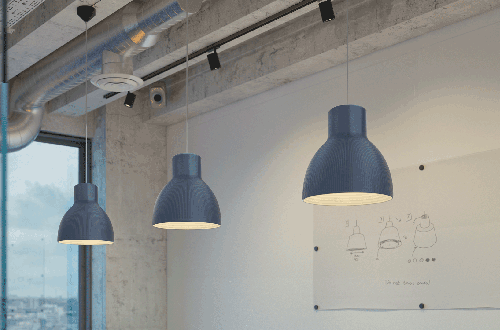
Good processability in extrusion and printing led to launch the Signify myCreation URBAN GREY product line. For the first time, a true circularity story of End-of-Waste lighting waste is being reintroduced as a closed-loop concept for a demanding optical application, introducing a material with 75% recycled content.
Key Benefits
- High Recycled Content - The new lampshades contain 75% recycled polycarbonate (ISO 14021), valorizing a waste stream which traditionally would end up in incineration, significantly reducing PC waste.
- On-Demand Production - 3D printing enables manufacturing only as needed, preventing overproduction.
- Design & Affordability - The resulting lampshades are both stylish and cost-effective.